Medicines are supposed to be the easy part. You get a prescription, the pain settles, life carries on.
Then it doesn’t work like that. Or it works for a while and stops. Or it works, but you’re so drowsy and unsteady that you’d almost rather have the pain. That’s usually the point where people start searching for what comes next.
So, is microvascular decompression (MVD) an option once medicines have let you down? Often it’s worth discussing. Not always, though. Let’s go through it.
What “failed” actually means
Doctors don’t use the word the way people think. It doesn’t mean you did something wrong.
It can mean the pain isn’t controlled even at the doses you can safely take. Or the medicine worked earlier and slowly stopped. Or the side effects, like sleepiness, dizziness, feeling foggy, are hard to live with. Sometimes the dose keeps going up and the relief doesn’t keep pace.
Any of these is a good reason to go back to your doctor. Not a reason to quietly put up with it.
Don’t stop the tablets on your own
Bit of an important one. If your medicines aren’t helping, it’s tempting to just stop. Please don’t.
Changing or stopping them suddenly can cause problems of its own. Your doctor will guide you on adjusting, switching or reducing, step by step.
First, is it really trigeminal neuralgia?
Sounds like a basic question, but it matters. Facial pain has many causes. Dental problems, sinus issues, other nerve conditions. Some of these look similar and get treated as trigeminal neuralgia for a long time.
If the medicines aren’t working, a fresh look at the diagnosis is a sensible step. History, examination and a proper MRI usually come before any talk of surgery.
So where does MVD come in?
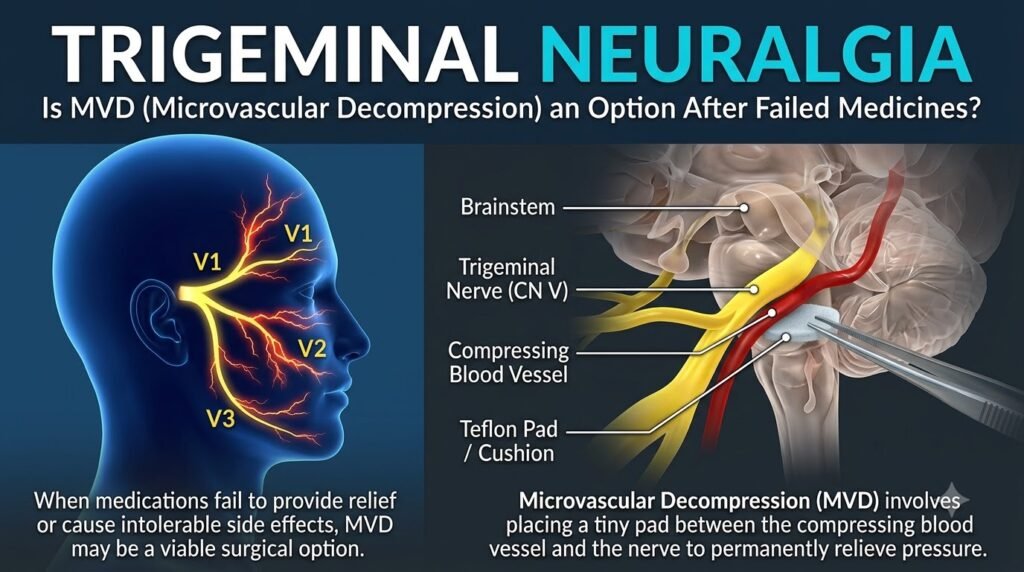
MVD is a surgery for cases where a blood vessel is pressing on the trigeminal nerve. The surgeon moves the vessel away and places a small protective cushion between the two. It aims at the cause, not just the pain signal.
That’s why the MRI matters so much. If the scan and your symptoms point to vascular compression, and you’re fit for surgery, MVD becomes a real option to discuss. Especially when medicines have stopped doing their job.
But “medicines failed” alone doesn’t make someone a candidate. Age, general health, scan findings, the nature of the pain and earlier treatments all count.
For patients considering MVD surgery for facial pain, the decision should be based on their symptoms, MRI findings, overall health and previous treatment response.
What if MVD isn’t the right fit?
That happens, and it isn’t the end of the road.
If surgery is a worry because of age or other health problems, or if the scan doesn’t show clear compression, other procedures can be considered. Radiofrequency, for example, is needle-based and less invasive, though it can cause facial numbness. Other options exist too, depending on the case. Your doctor can explain which ones apply to you.
Different tools, different trade-offs. Nothing is a guaranteed permanent cure.
What to carry to the consultation
A short list helps more than people think:
- Your MRI films and report
- Names and doses of every medicine you’ve tried, and for how long
- What the side effects were
- Any earlier procedures
- A rough note of where the pain is, what triggers it, how often it comes
If you can note down two or three attacks, even better. Doctors work from details.
The risks, said plainly
MVD is neurosurgery. Possible issues include hearing changes, facial numbness, balance problems, a leak of the fluid around the brain, infection, bleeding and anaesthesia-related risks. The pain can also return later. How likely any of this is depends on you, so ask about your own numbers, not general ones.
If medicines have stopped working for you, Dr. Deep Parmar can look at your symptoms, scans and treatment history and tell you whether MVD or another option makes sense.
If you are looking for the best neurosurgeon for MVD in India, it is important to discuss your individual case with an experienced neurosurgeon before deciding whether MVD is right for you.
Questions people usually ask
When should I think about surgery for trigeminal neuralgia?
Usually when medicines aren’t controlling the pain, or the side effects are too hard to manage. It’s a conversation to have with your doctor, not something to decide on your own.
Is MVD an option if my medicines have stopped working?
It can be, if your scan and symptoms suggest a blood vessel pressing on the nerve and you’re fit for surgery. A proper assessment decides this.
Does failed medication mean I need surgery?
Not automatically. “Sometimes just switching your medicine or tweaking the dose is enough to make a big difference. Your doctor will check everything first, and will only bring up a procedure if it’s really needed.”
Can I stop my medicines if they aren’t working?
Not on your own. Stopping suddenly can cause problems. Your doctor will guide you.
What tests are needed before MVD?
Usually a detailed history, examination and MRI, along with fitness checks for anaesthesia. Your surgeon will tell you what applies to you.
What if my MRI doesn’t show any compression?
Then MVD needs careful discussion, and other options may be considered. Your surgeon can explain what suits your case.
Is radiofrequency an option after medicines fail?
It can be, especially if surgery isn’t suitable. It’s less invasive, but it can cause facial numbness or altered sensation.
Will MVD stop my pain completely?
Many well-selected patients get good, long-lasting relief, but nothing is guaranteed and the pain can return.
Will I still need medicines after MVD?
Some people can reduce or stop them after a good result, but only under your surgeon’s guidance.

