Pediatric Neurosurgery: Common Conditions & Safe Treatments
Discovering that your child requires neurological care is a profound moment for any parent. However, pediatric neurosurgery has advanced to a point where many conditions that were once considered life-limiting are now highly treatable with excellent long-term outcomes.
Unlike adult neurosurgery, pediatric neurosurgery focuses on the developing nervous system. Because a child’s brain and spine are still growing, the approach must be specialized, minimally invasive whenever possible, and centered on the child’s future developmental milestones.
Why Pediatric Neurosurgery is Different
Children are not just “small adults.” Their physiology, metabolism, and ability to heal are distinct. Pediatric neurosurgeons undergo additional years of fellowship training specifically to understand:
- Neuroplasticity: The incredible ability of a child’s brain to reorganize itself after injury or surgery.
- Congenital Anomalies: Conditions present from birth that require early intervention to allow for normal growth.
- Family-Centered Care: A multidisciplinary approach involving pediatricians, neurologists, child life specialists, and therapists.
Common Pediatric Neurosurgical Conditions
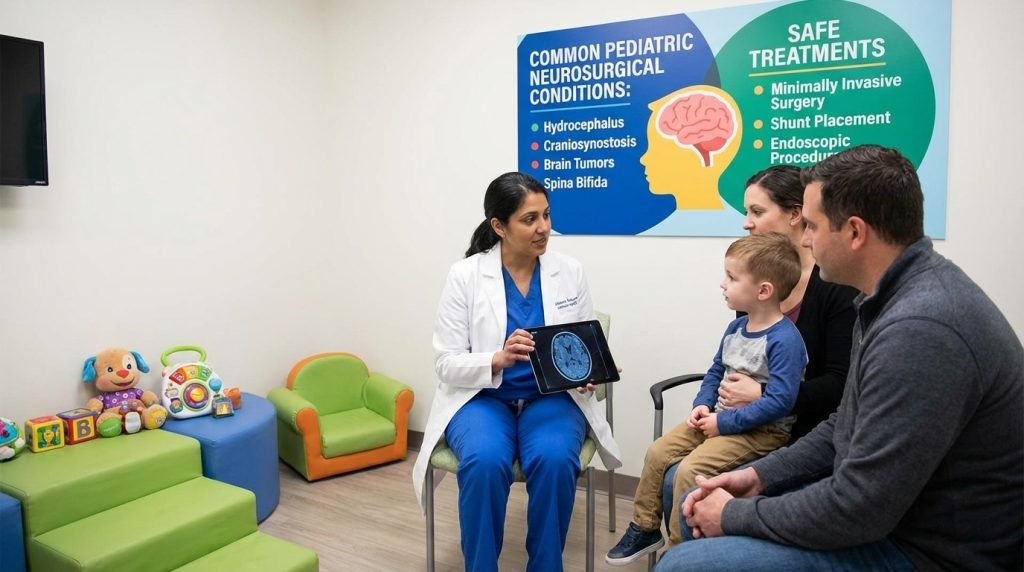
The scope of pediatric neurosurgery ranges from correcting skull shapes to treating complex tumors and spinal defects.
1. Hydrocephalus
Often called “water on the brain,” hydrocephalus occurs when excess cerebrospinal fluid (CSF) builds up in the ventricles of the brain. This increases pressure and can cause the head to enlarge.
- Symptoms in Infants: A bulging soft spot (fontanelle), unusually large head size, and “sunsetting” eyes (looking downward).
- Symptoms in Older Children: Headaches, nausea, and blurred vision.
2. Craniosynostosis
This condition occurs when the bones in a baby’s skull fuse together too early—before the brain has finished growing. This can result in an abnormally shaped head and, if left untreated, may restrict brain growth.
- Types: Sagittal synostosis (long, narrow head) is the most common.
- Impact: Beyond aesthetics, it can cause increased intracranial pressure.
3. Spina Bifida (Myelomeningocele)
A type of neural tube defect where the spine and spinal cord don’t form properly. In its most severe form, the spinal cord is exposed through an opening in the back.
- Advances: Many cases are now treated with fetal surgery (surgery while the baby is still in the womb) to improve mobility outcomes later in life.
4. Pediatric Brain Tumors
While rare, brain tumors are the most common solid tumors in children. Common types include medulloblastomas, astrocytomas, and ependymomas. Treatment focuses on removing the tumor while protecting the child’s cognitive and motor functions.
5. Drug-Resistant Epilepsy
When a child’s seizures cannot be controlled with medication, neurosurgery may be an option. Procedures like a vagus nerve stimulator (VNS) or focal resection (removing the specific area of the brain causing seizures) can offer a life-changing cure.
Safe and Innovative Treatment Options
Safety is the cornerstone of pediatric neurosurgery. Modern technology allows surgeons to be more precise than ever before, reducing the “footprint” of the surgery on the child’s body.
Minimally Invasive Endoscopy
Using an endoscope (a thin tube with a camera), surgeons can treat conditions like hydrocephalus or certain tumors through tiny incisions.
- ETV (Endoscopic Third Ventriculostomy): A safe alternative to traditional shunts for hydrocephalus, where the surgeon creates a small hole in the floor of the third ventricle to allow fluid to drain naturally.
Robotic-Assisted Surgery
Robotic platforms like ROSA are used for neuro-navigation during epilepsy surgery. This allows for the precise placement of electrodes to map seizure activity with sub-millimeter accuracy, making the procedure safer and faster.
Intraoperative MRI and Monitoring
Advanced “iMRI” suites allow surgeons to take brain images during surgery. This ensures that the entire tumor is removed before the procedure ends, reducing the need for repeat surgeries. Furthermore, neuromonitoring tracks nerve signals in real-time to ensure that speech and motor pathways remain protected.
Cranial Vault Remodeling
For craniosynostosis, surgeons use specialized techniques to reshape the skull. In many cases, endoscopic strip craniectomy combined with post-operative helmet therapy allows for a less invasive correction with minimal scarring.
The Path to Recovery: What Parents Should Expect
The recovery process for a child is often surprisingly fast due to their natural resilience. However, a structured recovery plan is vital.
- The ICU Stay: Most children spend 24–48 hours in a Pediatric Intensive Care Unit (PICU) for close monitoring.
- Pain Management: Specialized pediatric anesthesiologists use multi-modal pain relief to keep children comfortable while minimizing the use of heavy sedatives.
- Rehabilitation: Depending on the procedure, your child may benefit from physical therapy (PT) or occupational therapy (OT) to help them meet developmental milestones.
- Follow-up Care: Pediatric neurosurgery patients are often followed for years to monitor growth and development.
Choosing the Right Pediatric Neurosurgical Team
When evaluating a hospital or surgeon, parents should look for:
- Board Certification: Ensure the surgeon is board-certified specifically in pediatric neurosurgery.
- Volume and Experience: Ask how many procedures of your child’s specific type the center performs annually.
- Integrated Support: A center that provides child life specialists, social workers, and pediatric nutritionists to support the whole family.

