Most individuals suffering from trigeminal neuralgia don’t turn up asking about having a procedure carried out; instead they visit because eating has become a problem, or brushing their teeth has, or a little bit of wind on the face has.
The pain is sudden and quite sharp, similar to an electric shock on one side. Medicine is generally tried first, and it helps a great many people. Only when it stops being effective or when the side effects become too severe do people then consider MVD and radiofrequency.
Then who should we choose? To be honest, there is no single answer; it all comes down to the cause of your pain, what the MRI reveals, your overall health, and the treatments you’ve already tried. Everyone is looking for a clear solution here, but this isn’t a question that has one.
MVD first
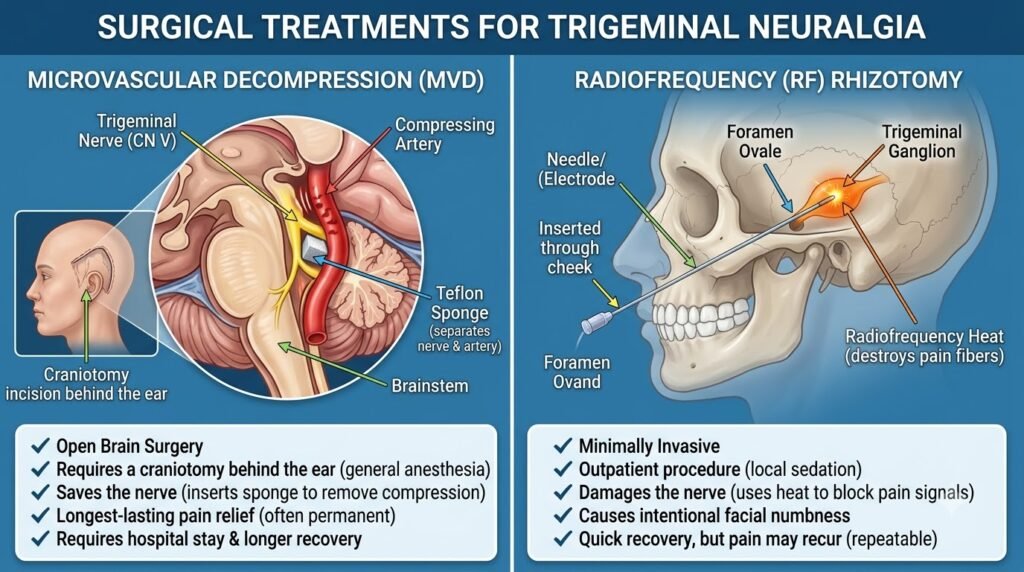
Microvascular decompression (MVD) is used in instances where a blood vessel is pressing on the trigeminal nerve, since that pressure continues to irritate the nerve and as a result the pain occurs.
During the operation the surgeon locates the nerve and shifts the vessel away from it; a small amount of protective material is usually placed between the two to prevent them touching again. The aim is to treat the cause, not merely to stop the signal.
It is proper neurosurgery, so there’s no point in presenting it as if it were less so; surgery is generally recommended when the scan and the symptoms indicate compression and the individual is fit enough for surgery.
Radiofrequency
The needle is directed to the nerve and radiofrequency energy, which is controlled, is used to stop the pain signals. There is no need for open surgery.
For someone who is not a good candidate for major surgery or who just prefers a less invasive procedure, it could be a practical choice.
The part that people should be told about early is that since it acts directly on the nerves, facial numbness or a changed sensation might occur, the extent of this varying from person to person; therefore, it is important to ask about it before the procedure, not after.
“Surgery is scary, so RF must be safer”
Not really, the risks are just different. MVD has its surgical risks, while radiofrequency is less invasive, though the nerve is deliberately targeted and therefore numbness is a real possibility.
The pain may return following either of the procedures. It’s not acceptable to market any procedure as a guaranteed permanent cure. If a person makes such a promise, you should be a bit cautious.
It’s all right for some people to have a little numbness as long as the pain has stopped. Others, however, can’t tolerate the idea of it. Both attitudes are reasonable, so it’s worth finding out which one suits you before making a decision.
How it actually gets decided
It isn’t based on a chart; instead, it takes into account the pain itself—where the pain is, what causes it, how long it has been occurring, the medications you’ve already tried, and whether the MRI indicates that the nerve is being compressed.
A younger person who is in other respects healthy might be given different advice from an older person who has other health problems. However, that is only a very general description. Actual cases are more complicated.
There is no way around it; you can only go so far by just comparing the two procedures on paper.
When you’re considering your choices, Dr. Deep Parmar will be able to go over your symptoms, scans and previous treatments and advise you as to whether MVD, radiofrequency or neither of these procedures is suitable for you. Don’t forget to take your MRI and the old prescriptions with you since this actually makes a difference.
If you are looking for the best neurosurgeon for MVD in India, it is important to discuss your condition with a neurosurgeon who can assess your symptoms, imaging and overall health before recommending a treatment.
If the pain is already making it difficult for you to eat, talk or brush your teeth, then don’t continue to put up with it—get the cause properly checked.
Questions people usually ask
Is the MVD a large operation?
Right, it is a neurosurgical procedure and more invasive than the needle-based radiofrequency; nevertheless, one has to have a proper evaluation before being considered as a suitable candidate.
Which of the two is safer, MVD or radiofrequency?
It varies from person to person; radiofrequency is less invasive but may leave you with a numbness or an unusual sensation on your face. MVD involves the risks associated with any surgery, and since the risks are different, neither procedure is simply safer.
Which one lasts longer?
Both of them can provide good relief in the appropriate patients and can also observe the pain coming back; the duration for which it lasts varies from person to person.
Is it possible to entirely avoid surgery?
Yes, usually at the beginning. Medicines are taken as the first action. When they cease to be effective or the side effects become too severe, then procedures are considered.
Will my face become numb as a result of the MVD?
The aim of the MVD is to relieve pressure on the nerve without damaging it. However, complications are possible with any neurosurgery, and your surgeon will be able to tell you about the risks in your particular case.
Will my face become numb as a result of radiofrequency?
It is possible. There are some individuals who notice a numbing or a changed sensation in part of the face, and the extent to which this occurs. It should be discussed openly before the procedure.
Then what if the pain returns after radiofrequency?
It does happen; in some cases, depending on the symptoms and the previous procedure, further treatment might be advised.
And once it has gone through MVD, can it return?
Yes, since a great many patients who are carefully chosen do achieve long-term relief. It is still possible for the condition to return.
What should I do to find out which one is suitable for me?
Once the symptoms have been considered, the examination carried out and the MRI or other form of imaging done, your overall health and previous treatments are looked at. There is no one procedure that is suitable for every individual.

