Trigeminal neuralgia is not the same as regular facial pain. You may experience a sudden electric shock feeling, stabbing sensation or intense shooting pain on one side of the face. Even simple things such as eating, speaking, brushing your teeth or touching your face may trigger an episode.
For some people, medicines provide good control. For others, the relief is incomplete or the side effects become difficult to manage.
This is where Microvascular Decompression (MVD) surgery may be considered.
MVD is a surgical treatment for selected patients with trigeminal neuralgia. The goal is to take the pressure off the trigeminal nerve, not just control the pain.
What is Trigeminal Neuralgia?
Trigeminal neuralgia involves the trigeminal nerve, which carries sensation from the face to the brain. Irritation or compression of this nerve can lead to sudden attacks of severe facial pain.
The pain may last only a few seconds, but it can recur several times a day. Some patients also report some triggers such as washing face, shaving, chewing/talking.
Because the symptoms can sometimes resemble dental pain, people may visit a dentist first. If dental causes are ruled out and the pain is persistent and of the usual type, a neurological examination may be required.
What Is Microvascular Decompression Surgery (MVD)?
MVD ( Microvascular Decompression ) is a procedure used in the treatment of some cases of trigeminal neuralgia.
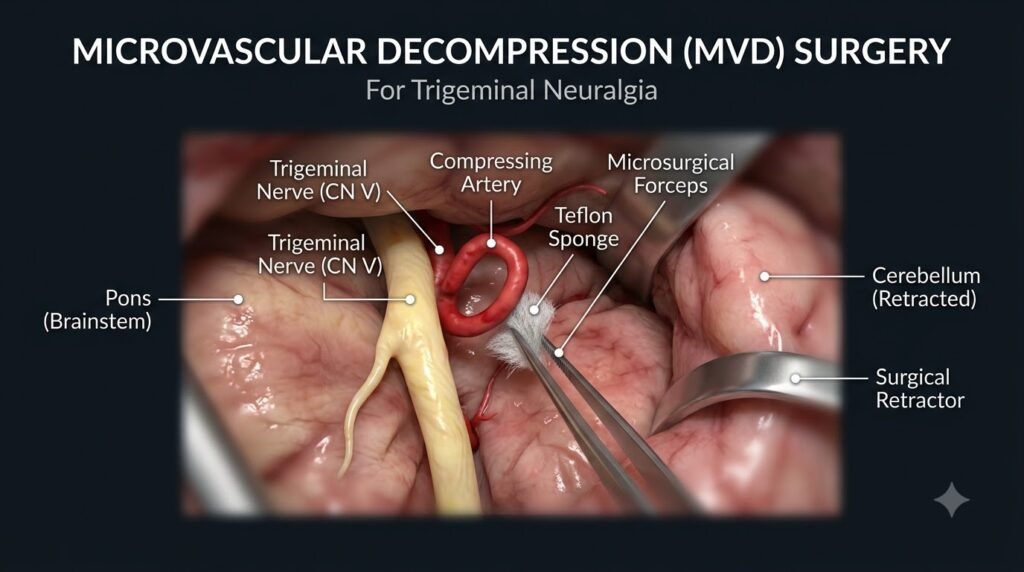
In some patients, a blood vessel is pressing on the trigeminal nerve near where it connects with the brainstem. This contact may cause irritation of the nerve and contribute to the characteristic facial pain.
In MVD surgery the surgeon identifies the blood vessel and separates it from the trigeminal nerve with care. A small protective material may be placed between them to prevent direct contact.
The main idea is quite simple: relieve the pressure on the nerve while trying to preserve the nerve itself.
MVD is performed under general anaesthesia and requires careful surgical planning.
When is MVD Surgery Recommended?
MVD is not suitable for every person with facial pain. A neurosurgeon will typically look at the patient’s symptoms, medical history, response to medicines, MRI findings and general health before recommending it.
MVD is an option in cases of:
- Severe or chronic pain due to trigeminal neuralgia.
- Inadequate relief from medications.
- Unmanageable side-effects from medicines.
- Imaging suggests vascular compression of the trigeminal nerve.
- The patient is medically fit for surgery.
The decision is personal. Having trigeminal neuralgia does not automatically mean that surgery is required.
How is MVD Surgery Performed?
MVD is performed under general anaesthesia.
The surgeon generally makes an incision behind the ear to access the area around the trigeminal nerve. Meticulous dissection of the nerve and nearby vessels.
If a blood vessel is pressing on the nerve, it is carefully moved out of the way. Then a small cushioning material can be placed between the vessel and the nerve.
The site of surgery is then closed and the patient is observed after the procedure.
The operation is performed near important nerves and blood vessels, so careful technique and appropriate patient selection are important.
What are the Advantages of MVD?
For selected patients, MVD can offer substantial relief of trigeminal neuralgia pain.
A major difference between MVD and some other treatment approaches is that it is directed at the suspected nerve compression. It is not simply a way of temporarily masking pain.
Patients who achieve good pain control may also be able to reduce their dependence on medication over time, but this should only be done under medical guidance.
At the same time, MVD should not be presented as a guaranteed permanent cure. Pain can return in some patients.
What are the Risks of MVD Surgery?
MVD is a major neurosurgical procedure and, like any surgery, has potential risks.
Possible complications include infection, bleeding, cerebrospinal fluid leakage, headache, balance problems, hearing changes or hearing loss, facial numbness or weakness and recurrence of trigeminal neuralgia.
There are also risks associated with general anaesthesia.
The level of risk varies between patients. A detailed discussion with your neurosurgeon is important before making a decision.
Recovery Following MVD Surgery
Patients are then followed up in hospital after surgery. It is normal to feel a little tired, have a headache, nausea or feel uncomfortable in the early recovery period.
Recovery doesn’t happen overnight.
Most patients require some time before they can return to their normal activities. Your doctor will give you information about medications, wound care, physical activity and follow up appointments.
If you develop a fever, worsening severe headache, wound problems, new weakness, significant changes in hearing, or other concerning symptoms after surgery, call your medical team immediately.
Will Trigeminal Neuralgia Return Following MVD?
Yes, this is possible.
For many of those who undergo MVD treatment, it is effective for pain management. But it doesn’t mean that some of those who are under this procedure will never suffer from pain again.
The likelihood of pain recurrence depends on multiple factors.
That is why follow-up remains important even when the initial result is good.
Frequently Asked Questions About MVD Surgery
Is MVD surgery painful?
The procedure is performed under general anaesthesia, so you will not feel the surgery itself. A headache, pain, or fatigue may arise during the recovery phase but can usually be treated through proper medical treatment.
How long is the recovery period following MVD?
The recovery period varies depending on each individual patient. Monitoring is done at the hospital after surgery before resuming normal activity. Your surgeon will advise you based on your recovery.
Can I stop my medicines after MVD surgery?
Do not stop trigeminal neuralgia medication without medical advice. If you notice that your pain improves considerably, then your doctor will start decreasing the dosage or modifying the medication.
Is MVD procedure a safe treatment?
It is a well-proven method, but it is surgery nonetheless and can entail certain dangers. It is best to have a consultation with a specialist.
Is MVD a permanent cure for trigeminal neuralgia?
MVD can provide long-term pain relief for many suitable patients, but no procedure can guarantee that pain will never return.
Is MRI needed before MVD surgery?
MRI is commonly part of the evaluation for trigeminal neuralgia. It assists doctors in studying the anatomy near the trigeminal nerve to detect any vascular compression.
When to Seek a Specialist?
Repeated electric-shock-like or stabbing facial pain should not simply be ignored, especially when everyday activities such as eating, talking or brushing your teeth trigger it.
If you are looking for the best neurosurgeon for MVD in India, it is important to choose a specialist experienced in treating trigeminal neuralgia and facial pain.
MVD surgery for facial pain may be considered when symptoms are severe, persistent, and linked to compression of the trigeminal nerve.
Getting the diagnosis right is the first step. Based on your symptoms and test results, you might require medication and/or surgery such as MVD for treatment.
If you have been diagnosed with trigeminal neuralgia or you have chronic face pain, Dr. Deep Parmar will review your case to decide what the best course of treatment is, which may involve MVD.

