
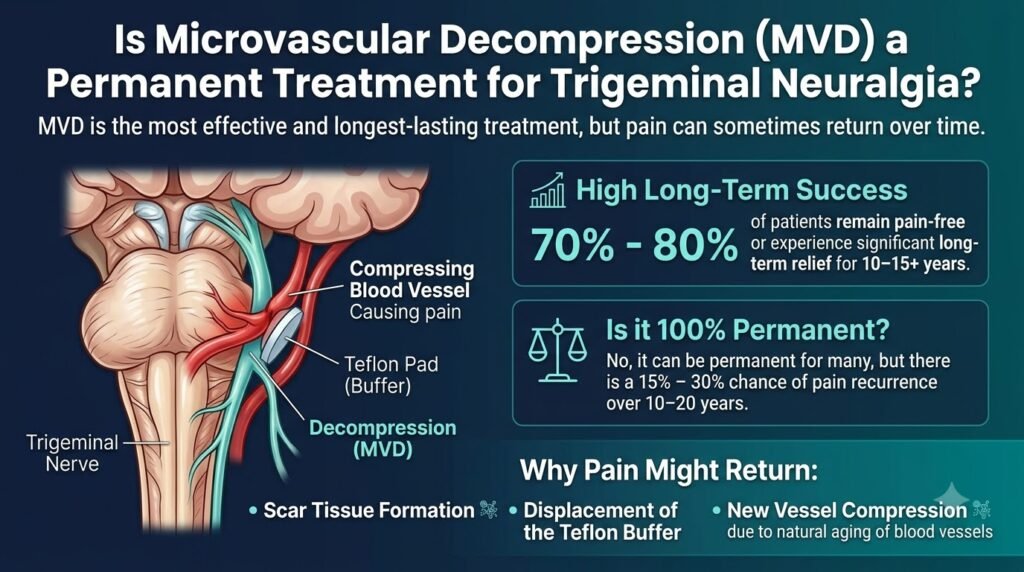
Is Microvascular Decompression a Permanent Treatment for Trigeminal Neuralgia?
If you’ve been living with trigeminal neuralgia, you’ve probably searched for one thing at some point: something that fixes it for good.
Fair. Nobody wants to plan their life around the next attack.
So, is microvascular decompression (MVD) that fix? Honestly, for the right patient it’s the closest thing to a root-cause treatment. But permanent? That’s a promise nobody should make.
Why MVD is different
Most treatments work on the pain signal. Medicines calm the nerve. Procedures like radiofrequency interrupt it.
MVD goes after the cause, when there is one. If a blood vessel is pressing on the trigeminal nerve, the surgeon moves it away and places a small cushion between the two. Nothing is cut, nothing is burnt.
That’s why many surgeons see MVD as the more fundamental option for patients with clear compression on the scan.
Clear compression. Those are the words that matter. Not everyone has it.
So why not call it permanent?
Because nerves and blood vessels don’t follow textbooks.
Pain can come back after MVD. Sometimes a vessel shifts, or the cushion moves, or another vessel starts pressing. Sometimes the nerve was irritated for so long that it doesn’t fully settle. Sometimes there’s no clear reason at all.
Some people get relief that lasts many years. Some find it fades sooner. And in some cases the relief is only partial. Nobody can tell you which group you’ll fall into before the surgery, and anyone who claims to is guessing.
“Long-lasting” is a fair word. “Permanent” isn’t.
What affects how well it works
There’s no neat formula, but a few things count:
- Whether the MRI and the surgery actually show a vessel pressing on the nerve
- The kind of pain. Sharp, shock-like attacks often respond differently from constant burning or aching pain
- How long you’ve had it
- Whether you’ve had other procedures earlier
- Your general health
Your surgeon can tell you where you fit. Bring your scans and your medicine history, it makes the conversation much more useful.
What if the pain comes back?
First, don’t panic. Sometimes it returns milder than before. Sometimes it’s the same.
Either way, tell your surgeon and get it assessed. Medicines may help again. Imaging might be repeated. Depending on your case, other options, including another procedure, can be discussed.
What you shouldn’t do is sit on it for months, thinking you’ve failed or that nothing else can be done. That’s not usually true.
And your medicines?
After a good result, many people are able to reduce or stop their medicines. But that’s your surgeon’s call, step by step. Stopping on your own, even when you feel perfectly fine, isn’t a good idea.
A better question to ask
“Will this cure me forever?” is a natural question. It just doesn’t have an honest yes or no.
A better one: what are my realistic chances of long relief, and what risks am I accepting for it? MVD is neurosurgery, so the risks are real. These can include hearing changes, facial numbness, balance problems, a leak of the fluid around the brain, infection, bleeding and anaesthesia-related issues. How likely any of these are depends on you.
Ask about both sides before you decide.
If you’re weighing MVD, Dr. Deep Parmar can go through your symptoms, MRI and earlier treatments with you, and tell you whether it makes sense for your case.
For patients considering MVD surgery for facial pain, the decision should be based on the cause of the pain, imaging findings, overall health and expected benefits and risks.
If you are looking for the best neurosurgeon for MVD in India, it is important to discuss your individual case with an experienced neurosurgeon before deciding whether MVD is right for you.
Questions people usually ask
Is MVD a permanent cure for trigeminal neuralgia?
Not guaranteed. Many well-selected patients get long-term relief, but the pain can return in some cases.
How long does relief after MVD last?
It varies. Some people stay pain-free for many years, others for a shorter time. Your surgeon can give a better idea after looking at your case.
Who gets the best results from MVD?
Usually patients whose scan and symptoms point to a blood vessel pressing on the nerve, and who are fit for surgery. Your surgeon decides this after a proper assessment.
Can trigeminal neuralgia come back after MVD?
Yes.“Yes. Doctors don’t always say this out loud, but the pain can come back even after a good result.”
What happens if the pain returns?
You’ll need a fresh assessment. Medicines, repeat imaging or another procedure may be considered, depending on your situation.
Will I be able to stop my medicines after MVD?
Many patients can reduce them after a good outcome, but only under your surgeon’s guidance. Never stop on your own.
Is radiofrequency more permanent than MVD?
Neither is guaranteed. “Neither can promise it. They work in different ways, with different risks, so the choice depends on your scan, your health and your preference.”
No procedure should be promised as a guaranteed permanent cure. The aim is long-lasting relief with risks you understand and accept.
Should I get MVD if my MRI shows no compression?
That needs careful discussion with your surgeon. MVD is generally considered when imaging and symptoms suggest vascular compression.

