Imagine a jolt of pain so sharp it feels like an electric shock to your face. It hits while you brush your teeth, drink water, or step out into the wind. For people with trigeminal neuralgia, this is not a rare bad day. It can become a daily fear.
Medicines help many people at first. But when they stop working, or the side effects start to feel as bad as the pain, it’s natural to ask what else is possible. One option is microvascular decompression, or MVD. So who is actually an MVD surgery candidate? Let’s go through it in plain language.
What Is Microvascular Decompression?
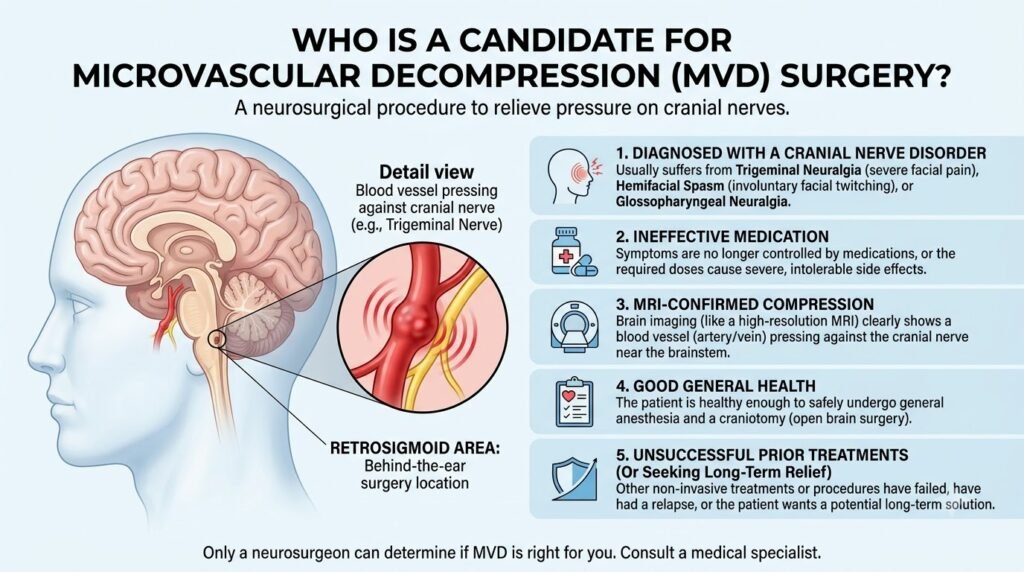
Deep inside the skull, near the brainstem, nerves sometimes get pressed by a nearby blood vessel. Over the years, that steady pressure wears on the nerve and makes it fire off signals it shouldn’t.That misfiring is what you feel as pain or involuntary twitching.
In MVD, the surgeon makes a small opening behind the ear and gently moves the vessel away from the nerve. A tiny soft cushion is placed in between so the two stay apart. The idea is simple. Instead of only calming the symptoms, the surgery fixes the cause.
Conditions MVD Can Treat
MVD is mainly used for:
Trigeminal neuralgia: sudden, stabbing, electric-shock-like pain on one side of the face.
Hemifacial spasm: one side of your face twitches or tightens on its own, and you can’t make it stop.
Glossopharyngeal neuralgia: a rarer condition that causes sharp, stabbing pain in the throat, tongue, or ear.
Who Is a Good Candidate for MVD Surgery?
Every case is different, so there’s no single answer. But there are a few things doctors usually look at first.
1. A confirmed diagnosis. Before anything else, a specialist needs to be sure about what’s causing your symptoms. First, a specialist needs to be sure about what’s causing your symptoms. Typical trigeminal neuralgia, with its sudden, shock-like attacks, responds best to this surgery.
2. Signs of nerve compression on MRI. A high-quality MRI often shows whether a blood vessel is pressing on the nerve. This is one of the most important pieces of the puzzle.
3. Medicines aren’t enough anymore. Maybe the pain keeps breaking through. Maybe the dose has gone up again and again. If tablets are no longer giving steady relief, surgery becomes worth discussing.
4. The side effects are becoming a problem. Some pain medicines can leave you drowsy, dizzy, or foggy. If that’s making it hard to work or be present with your family, it’s worth talking to your doctor about.
5. Daily life is suffering. Eating, talking, sleeping, even washing your face can become difficult. When pain starts deciding how you live, that’s a strong reason to explore treatment.
6. You’re healthy enough for surgery. MVD is brain surgery done under general anaesthesia, so your overall health needs to be able to handle it.
7. You understand what to expect. A good candidate knows the benefits, the possible risks, and what recovery looks like, and is comfortable with the decision.
When MVD May Not Be the Right Choice
MVD doesn’t suit everyone, and that’s okay. It may be less suitable if:
The MRI doesn’t show a vessel pressing on the nerve.
The pain is caused by something else, such as multiple sclerosis or a tumour.
If your pain is constant rather than sudden and shock-like, or if other health problems make surgery or anaesthesia risky, MVD may not be the right choice for you. That doesn’t mean you’re out of options. Treatments like radiosurgery or procedures that target the nerve can still bring relief, and a specialist can help you work out which one fits your situation best.
How the Evaluation Works
Nobody should jump straight to surgery. It starts with a proper conversation. Your doctor will start by simply listening. How often does the pain show up? What sets it off? How much does it get in the way of your day? After that, there’s a neurological check-up and a detailed MRI to see what’s going on around the nerve. Your doctor will also want to know which medicines you’ve already tried and how your body reacted to each one.All of this helps build a clear picture before any decision is made. Then you’ll talk through the benefits, risks, and alternatives together. Nothing is rushed, and the decision is shared.
For people considering MVD surgery for facial pain, this evaluation helps determine whether the symptoms, MRI findings and overall health make surgery an appropriate option.
What Recovery Looks Like
Most people stay in the hospital for a few days after surgery. Many notice relief fairly early, though everyone heals at their own pace. You’ll have follow-up visits, and your doctor will tell you when to ease back into normal routines.
When Should You See a Specialist?
Don’t wait it out if you notice any of these:
Facial pain that is severe, sudden, or keeps coming back
Medicines that no longer control the pain
Facial twitching that is slowly getting worse
Pain that makes eating, speaking, or sleeping hard
The sooner you get a proper diagnosis, the more options you’ll have.
Frequently Asked Questions
Is MVD Surgery safe?
Like any brain surgery, it carries risks, and your surgeon will explain them before you decide. In experienced hands, it is a well-established procedure for the right patient.
Will the pain come back after surgery?
Many patients get long-lasting relief, but in some people the pain can return over time. Your doctor can tell you what to expect in your case.
How long does recovery take?
Hospital stay is usually a few days, and full recovery takes a few weeks. It varies from person to person.
Is MVD better than medicines?
Medicines are usually the first step. MVD is considered when medicines stop working or cause problems, because it addresses the actual cause of the pain.
Can anyone with facial pain get MVD?
No. It works best for typical trigeminal neuralgia or hemifacial spasm with proven nerve compression. Other types of facial pain may need different treatment.
How do I know if I’m a candidate?
A neurosurgeon will review your history and MRI scans. That’s the only reliable way to know.
Final Thoughts
An MVD surgery candidate is usually someone with a confirmed diagnosis, MRI evidence of nerve compression, and pain that medicines no longer control well. If that sounds familiar, you don’t have to keep living around the pain.
The best first step is a proper evaluation. If this sounds like what you or someone you love is going through, a conversation with Dr Deep Parmar can help you find out whether microvascular decompression is the right step for you. If you are looking for the best neurosurgeon for MVD in India, an experienced neurosurgical evaluation can help you understand whether MVD is appropriate for your specific case. Book a consultation today.

