Most people who ask about MVD aren’t scared of the surgery as such. They’re scared of not knowing what goes on in there.
Fair enough. “Brain surgery” is a heavy phrase, and the explanation usually stops at “we’ll move the blood vessel away from the nerve.” So here’s the longer version, in order.
A quick reminder first. Microvascular decompression (MVD) is done when a blood vessel is pressing on the trigeminal nerve and causing the pain. It tries to fix that pressure, not just block the signal. Details can differ from surgeon to surgeon and from case to case, so treat this as a general picture, not your personal plan.
Before the day
Surgery doesn’t start in the operating room. It starts with the MRI, the history, and a proper look at whether MVD even makes sense for you.
Which medicines you’ve tried, how the pain behaves, your general health, and any blood thinners you’re on. All of that gets sorted out beforehand. You’ll usually have blood tests and a fitness check for anaesthesia too.
Ask what to stop and when. Don’t guess on medicines.
Anaesthesia and positioning
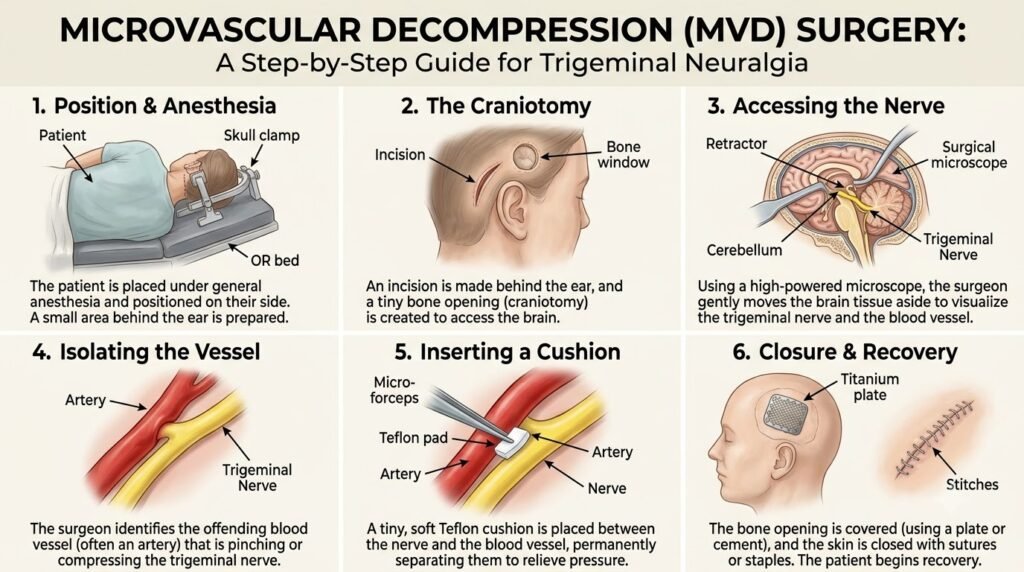
MVD is done under general anaesthesia, so you’re asleep. You won’t feel or remember any of it.
Once you’re asleep, the head is positioned and held steady, usually turned to the side so the surgeon can reach the right spot behind the ear. Stability matters because the work is very fine.
The opening
A small incision is made behind the ear on the painful side. Then a small opening is made in the bone to reach the covering of the brain. It’s a small window, not a big removal.
The covering is opened carefully, and the surgeon works with a microscope (some use an endoscope as well). Magnification is the whole point here. The structures are tiny.
Finding the problem
This is the core of it. The surgeon gently makes space to reach the trigeminal nerve and looks at where it’s being pressed by a blood vessel, usually an artery.
Sometimes the compression is obvious. Sometimes it takes more careful looking. That’s why the MRI beforehand helps, but what’s actually seen during surgery is what guides the next step.
Moving the vessel away
Once the vessel is found, it’s carefully separated from the nerve. A small piece of soft protective material is then placed between them, so the two don’t sit against each other again.
That’s the decompression. Nothing is cut and nothing is burnt. The vessel stays where it belongs, just not touching the nerve.
Short step, but it takes the most care.
Closing up
After that, the covering is closed, the bone opening is repaired, and the skin is stitched. Then you’re woken up and shifted for monitoring.
How long the whole thing takes depends on the case. Usually a few hours, but don’t hold anyone to a number. Ask your surgeon what to expect for you.
After the surgery
You’ll be watched closely at first. Headache, tiredness, a bit of nausea, soreness near the incision. These are common early on, and the team will manage them.
Hospital stay and activity limits vary. Your surgeon will tell you what to avoid and when to come back. Some people notice pain relief fairly soon. For others it’s slower. Either way, follow the instructions you were given and don’t self-adjust your medicines without asking.
Risks, said plainly
Every surgery has them, and MVD is no exception. Possible issues include hearing changes, facial numbness, balance problems, a leak of the fluid around the brain, infection, bleeding, and anaesthesia-related risks. And the pain can return later even after a good result.
How likely any of this is depends on you and your case. That’s a conversation for your surgeon, with your scans in front of you.
If you’re thinking about MVD, Dr. Deep Parmar can go through your symptoms, MRI and earlier treatment and tell you if it suits you. Carry your reports and old prescriptions. It saves time.
For patients considering MVD surgery for facial pain, the decision should be based on the cause of the pain, MRI findings, symptoms and overall health rather than on the procedure alone.
If you are looking for the best neurosurgeon for MVD in India, it is important to discuss your case with an experienced neurosurgeon who can assess whether MVD is appropriate for you.
Questions people usually ask
Is MVD surgery done under general anaesthesia?
Yes. You’re asleep for the whole procedure.
Will my head be shaved?
Usually only a small area near the incision is trimmed, though it can vary. Ask your surgical team beforehand.
How long does MVD take?
Usually a few hours, but it depends on the case. Your surgeon can give a better idea for you.
Is it painful afterwards?
Some soreness and headache near the incision is common in the early days. Pain medicines are given, and the team keeps an eye on it.
How long will I stay in hospital?
It varies by hospital and by patient. Your surgeon will tell you what to expect.
Will my face go numb after MVD?
MVD aims to take pressure off the nerve, not damage it. Still, any neurosurgery can have complications, and numbness is one of the things worth asking about.
Does the pain go away immediately?
Some people feel better quite soon, others take longer. It isn’t the same for everyone.
Can the pain come back after MVD?
It can. Many well-selected patients get long-term relief, but recurrence is still possible.
Who is a good candidate for MVD?
Usually someone whose scan and symptoms point to a blood vessel pressing on the nerve, and who is fit enough for surgery. Your surgeon decides this after a proper assessment.
When can I get back to normal activities?
Depends on how you’re recovering, and what your work involves. A desk job and a physical job won’t have the same timeline. Your surgeon will tell you when to rest, when you can drive, and when to go back to work.

